
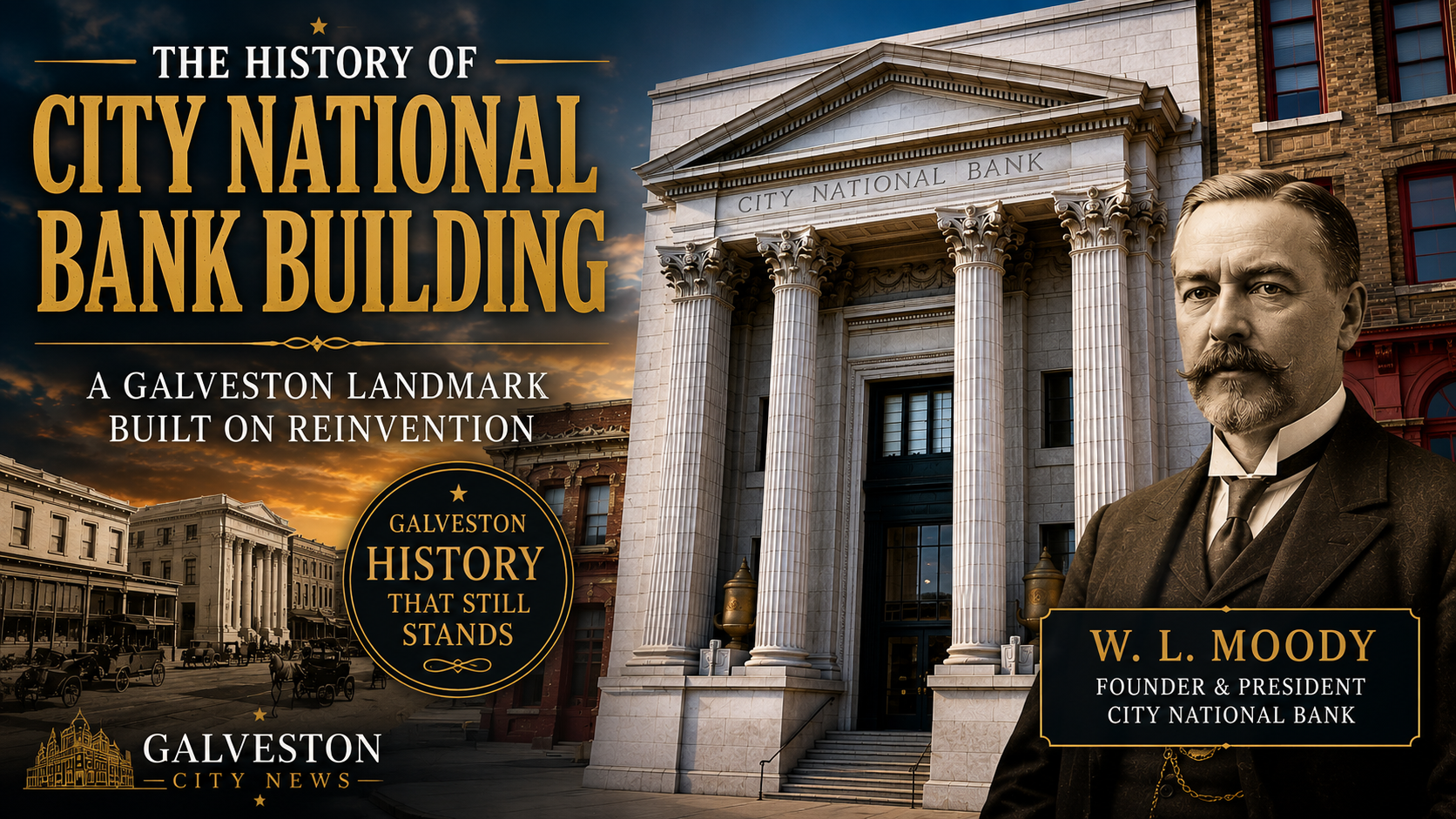
City National Bank Building Galveston: History & W.L. Moody
GALVESTON, Texas — Among the historic buildings of downtown Galveston, the former City National Bank Building is difficult to miss.
Its massive Corinthian columns, stone façade and temple-like entrance stand in sharp contrast to many of the ornate Victorian commercial buildings nearby. Above the entrance, the original name remains carved into the stone:
CITY NATIONAL BANK.
The historic bank building represents an important chapter in Galveston history — the period when the island was rebuilding and reinventing itself following the devastating 1900 Galveston hurricane.
A Bank Built for a Changing Galveston
The architecture of the City National Bank Building was designed to communicate something immediately to anyone approaching its doors: strength.
During the late 19th and early 20th centuries, banks throughout the United States frequently adopted monumental classical architecture. Columns, stone façades and temple-like entrances were intended to convey permanence, stability and security.
Those ideas had particular meaning in Galveston.
The city had entered the 20th century after suffering one of the deadliest natural disasters in American history.
On September 8, 1900, a catastrophic hurricane and storm surge struck Galveston, killing thousands of people and destroying large portions of the city.
Galveston’s response was extraordinary.
Rather than abandon the island, local leaders embarked on massive engineering projects intended to protect the city from future hurricanes.
The Galveston Seawall was constructed along the Gulf of Mexico, while large portions of the island were physically elevated during the famous Galveston grade-raising project.
Homes, churches and commercial buildings were lifted while sand was pumped beneath them.
Galveston was literally rebuilding itself higher.
From the “Wall Street of the Southwest” to a New Era
Before the 1900 hurricane, Galveston had developed into one of the most important commercial cities in Texas.
Its natural harbor helped make the island a major gateway between Texas and the rest of the world.
Cotton moved through Galveston’s port. Railroads connected the island to the interior of Texas. Banks, insurance companies, shipping firms, wholesalers and commission merchants established offices throughout downtown.
The concentration of financial activity became so significant that The Strand became known as the “Wall Street of the Southwest.”
Many of those 19th-century commercial buildings still stand today.
Walking through downtown Galveston therefore reveals something unusual: several different periods of the city’s history remain visible within only a few blocks.
The Victorian buildings along The Strand represent Galveston’s explosive commercial growth during the 1800s.
Buildings such as City National Bank represent the city that emerged afterward.
It was still ambitious.
But the world around Galveston was changing.
Houston Begins to Challenge Galveston
During the early 20th century, Houston increasingly emerged as Galveston’s major economic competitor.
The development of the Houston Ship Channel allowed oceangoing vessels to travel directly to Houston, helping shift commerce and population growth toward the mainland.
Galveston would never again completely dominate Texas commerce as it had during portions of the 19th century.
Instead, the island began another reinvention.
And that transformation would eventually produce one of the most colorful periods in Galveston history.
The Free State of Galveston
During the 1920s, 1930s, 1940s and early 1950s, Galveston developed a national reputation for entertainment, gambling and vice.
The island became widely known as the “Free State of Galveston.”
Casinos and nightclubs attracted visitors from Houston and across Texas.
Two of the most famous figures associated with the era were Sam and Rosario “Rose” Maceo, Sicilian-born brothers who became powerful figures in Galveston’s entertainment and gambling industry.
Their establishments helped transform Galveston into a major Gulf Coast entertainment destination.
The legendary Balinese Room eventually became the most famous symbol of the era, attracting nationally known entertainers and visitors to the island.
Meanwhile, downtown Galveston’s banks, businesses and professional offices continued operating only a short distance away.
That contrast became part of what made Galveston unique.
It was simultaneously a historic port city, financial center, tourist destination and famously permissive entertainment town.
Galveston’s History Is Still Standing
Today, the former City National Bank Building remains one of the most imposing structures in downtown Galveston.
Modern vehicles now park beneath its columns. Businesses have changed. The surrounding city has evolved dramatically.
But the architecture remains.
Look closely at downtown Galveston and the buildings themselves reveal the city’s timeline.
There are structures that witnessed the Civil War.
There are buildings constructed during Galveston’s great Victorian commercial boom.
There are survivors of the Great Storm of 1900.
And there are buildings representing the city’s determination to rebuild and reinvent itself during the decades that followed.
The former City National Bank Building belongs to that continuing story.
Its enormous columns were designed to project permanence.
More than a century later, they still do.
For visitors walking through historic downtown Galveston, it is another reminder that the island’s history isn’t hidden away inside museums.
Much of it is still standing along the streets.
Galveston City News
Your City. Your Story.


