
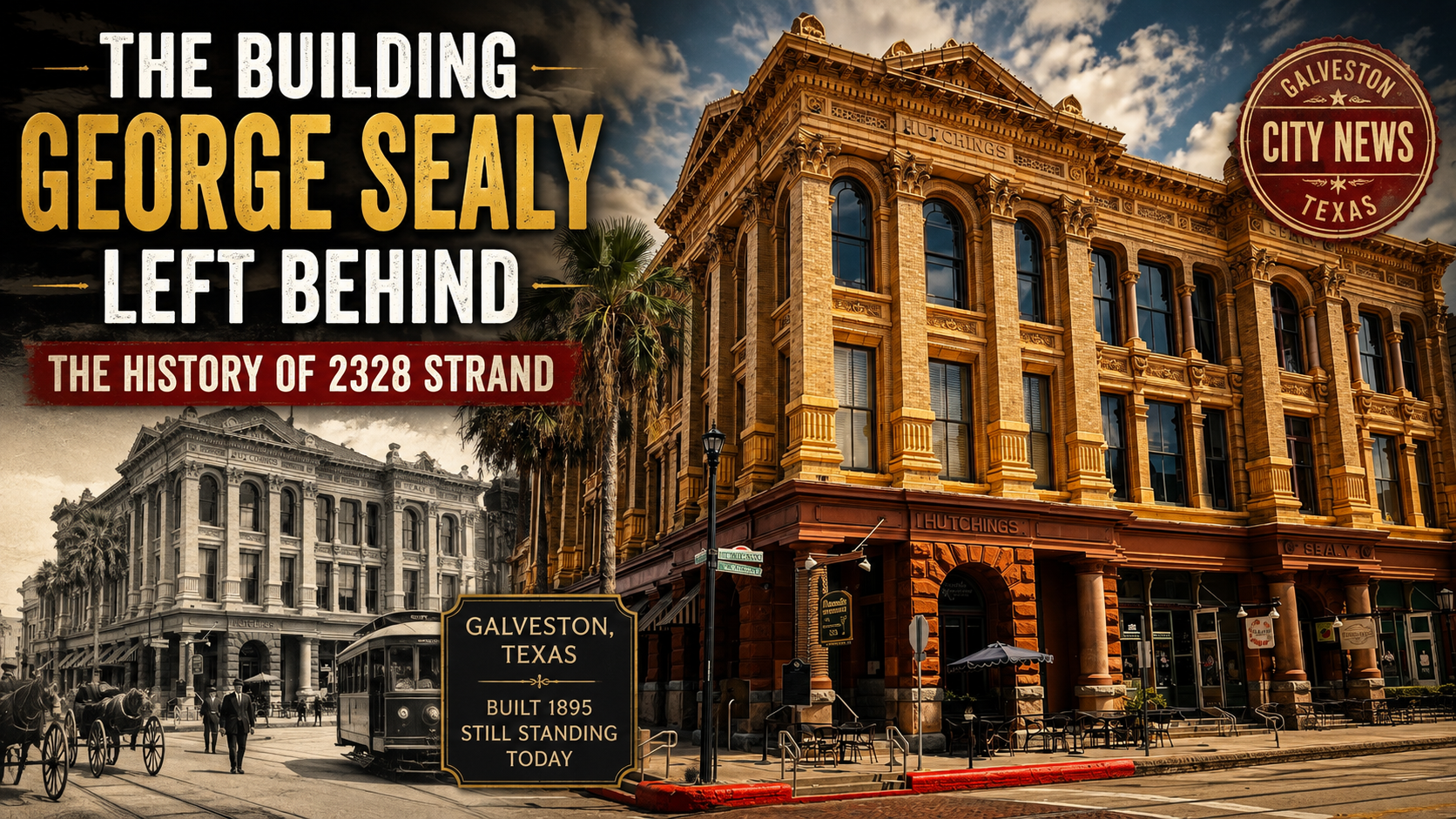
The Hutchings-Sealy Building: History of 2328 Strand in Galveston
GALVESTON, Texas — At the corner of 24th Street and The Strand stands a building from an era when Galveston wasn’t primarily known as a beach destination.
It was a city of money.
Look toward the top of the ornate building at 2328 Strand, and two names are still carved into its façade more than a century later:
HUTCHINGS. SEALY.
Today, visitors walk beneath those names on their way through Galveston’s historic downtown. But in the late 19th century, they represented some of the most powerful business interests on the island.
The building is known as the Hutchings–Sealy Building, and its story provides a window into the period when Galveston was one of the most important commercial cities in Texas.
When The Strand Was Galveston’s Financial District
Long before souvenir shops, restaurants and cruise passengers filled downtown Galveston, The Strand was packed with bankers, cotton merchants, shipping agents, railroad executives and businessmen.
Galveston’s port connected Texas commerce with markets around the country and overseas.
Cotton and other commodities moved through the city’s wharves and warehouses. Railroads carried goods between the island and the rapidly developing Texas interior. Banks and commission houses financed much of that commerce.
The concentration of wealth became so significant that The Strand earned a famous nickname:
“The Wall Street of the Southwest.”
The Hutchings–Sealy Building stood directly in the middle of it.
The present building was constructed in 1895 for the interests associated with Ball, Hutchings & Co., the influential Galveston banking and commission house whose history was closely connected with John H. Hutchings and the Sealy family.
Among the men associated with that financial empire was George Sealy.
Who Was George Sealy?
George Sealy became one of the most influential businessmen in Galveston’s history.
Born in Pennsylvania in 1835, Sealy eventually made his way to Galveston and entered the business world being built by his brother, John Sealy, and businessman John H. Hutchings.
George Sealy’s interests extended far beyond a single banking house.
He became heavily involved in banking, transportation, real estate and railroad development and was particularly important in the development of the Gulf, Colorado & Santa Fe Railway.
Railroads were essential to Galveston’s ambitions.
The more effectively Galveston could connect its port with farms, ranches, towns and cities across Texas, the more commerce could move through the island.
For men such as Sealy, the railroad, the port and the financial institutions of The Strand were pieces of the same enormous economic system.
The Sealy name would eventually become permanently woven into Galveston’s identity through business, philanthropy, medicine and architecture.
George Sealy’s own residence, the spectacular Open Gates mansion on Broadway, became another enduring reminder of the family’s wealth and influence.
But if Broadway represented where Galveston’s elite lived, The Strand represented where much of their money was made.
A Building Designed to Make a Statement
The Hutchings–Sealy Building was designed by Nicholas J. Clayton, one of the most important architects in Galveston history.
Clayton’s work helped create the distinctive architectural character that still separates Galveston from almost every other Texas city.
The Hutchings–Sealy Building was no modest commercial structure.
Its massive arched windows, decorative masonry, columns, carved details and elaborate upper façade projected wealth and permanence.
That was appropriate for the neighborhood.
Imagine standing at the intersection outside the building during the final years of the 1890s.
Instead of automobiles, horses and wagons would have traveled along the streets. Streetcars moved through Galveston. Telegraph offices transmitted information across the country. Ships crowded the nearby waterfront.
Inside buildings along The Strand, businessmen studied ledgers, negotiated loans, bought and sold cotton, arranged shipments and financed ventures stretching hundreds of miles beyond the island.
Galveston was booming.
And the Hutchings–Sealy Building was almost brand new.
Then everything changed.
The Building That Watched the 1900 Storm Arrive
Only about five years after the present Hutchings–Sealy Building was completed, Galveston experienced the catastrophe that would forever divide the city’s history into a before and an after.
On September 8, 1900, a massive hurricane struck the island.
Storm surge swept across Galveston. Homes and buildings were destroyed. Thousands of people died in what remains the deadliest natural disaster in United States history.
The Hutchings–Sealy Building survived.
That fact gives the building a remarkable connection to the Galveston we know today.
The walls standing at 2328 Strand were already there when the hurricane arrived.
They witnessed one of the richest periods in Galveston’s history.
They survived its darkest day.
And they remained standing as the city began the enormous task of rebuilding.
Galveston Refused to Disappear
After the hurricane, Galveston’s leaders embarked upon engineering projects almost unimaginable in scale.
The city constructed its famous seawall.
Large sections of Galveston were also physically raised to reduce the danger from future storm surge. Buildings were elevated while enormous quantities of sand were pumped beneath them, changing the elevation of entire neighborhoods.
Galveston survived.
But the city’s trajectory changed.
Houston would eventually eclipse Galveston as the region’s dominant commercial center, particularly as the Houston Ship Channel transformed shipping and industry on the mainland.
The Strand’s days as the unquestioned “Wall Street of the Southwest” faded.
Yet many of its buildings remained.
More than a century later, that preservation has become one of Galveston’s greatest assets.
Look Up the Next Time You Walk The Strand
Thousands of people pass 2328 Strand every year without necessarily knowing the story written across its walls.
The next time you walk past the building, stop across the street and look toward the roofline.
You’ll still see the names.
HUTCHINGS.
SEALY.
They’re reminders of a Galveston that existed before the seawall, before the 1900 hurricane and before Houston became the economic giant it is today.
A Galveston filled with banks, cotton exchanges, railroad executives, shipping companies and businessmen convinced their island city was destined for even greater things.
The Hutchings–Sealy Building has now stood at the corner of 24th and Strand for more than 130 years.
George Sealy is gone.
The banking empire that once operated here belongs to history.
But the building remains.
And if you know where to look, Galveston still has a remarkable way of telling you exactly where its stories happened.


