
This Galveston Bar Is Hiding a Piece of The Strand’s Past
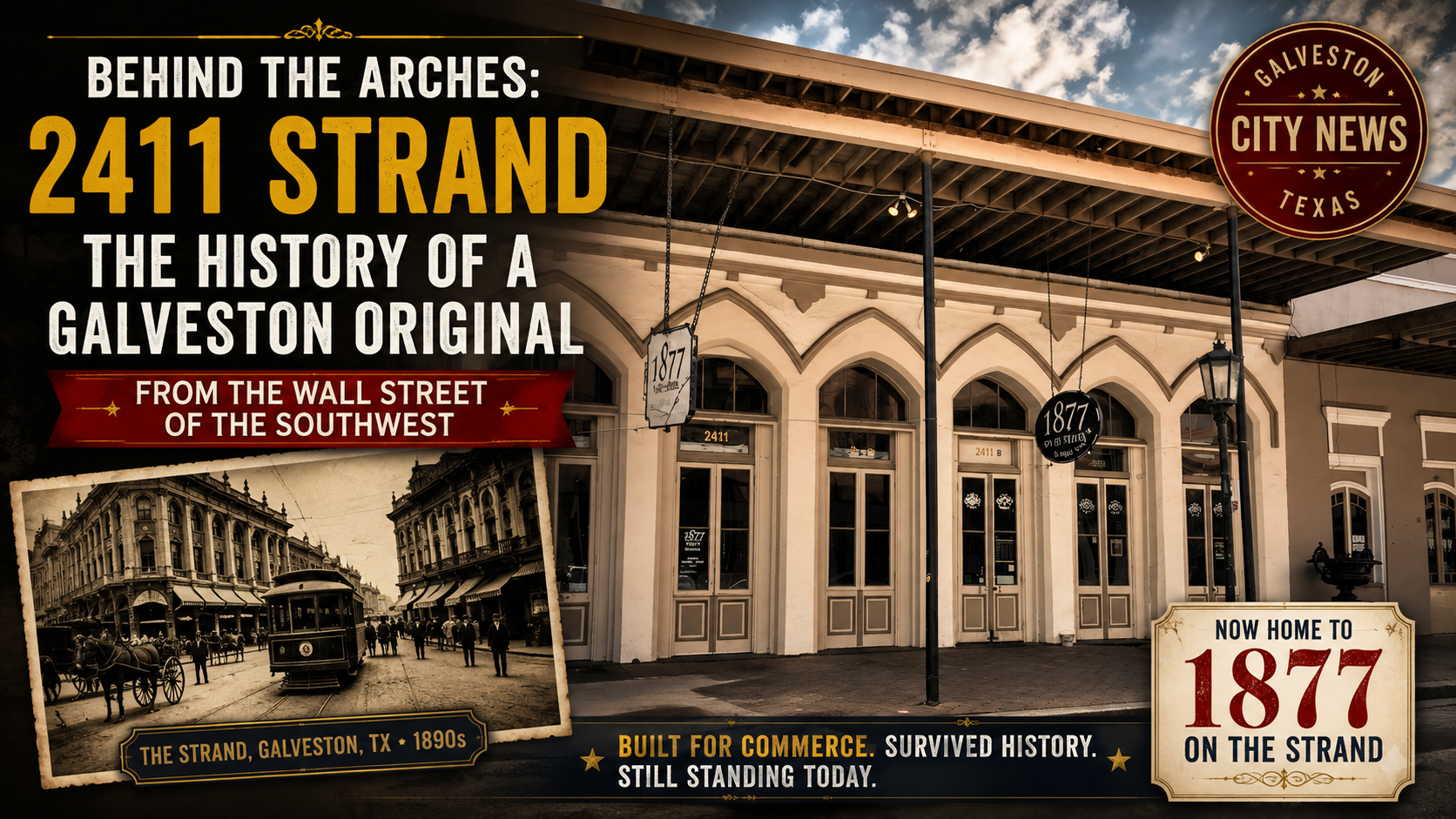
GALVESTON, Texas — Today, visitors walking along The Strand can step through a row of distinctive pointed arches at 2411 Strand and into 1877 on the Strand, a neighborhood bar in the heart of Galveston’s historic downtown.
But long before cocktails were being poured here, this block stood in the middle of one of the most important commercial districts in Texas.
Unlike the towering Victorian buildings that dominate much of The Strand, 2411 immediately stands out.
It is lower, simpler and dramatically different.
And its surviving façade offers another glimpse into the Galveston that existed when The Strand wasn’t a tourist attraction.
It was the economic heart of the city.
Look at the Arches
The most recognizable feature of 2411 Strand is impossible to miss.
A repeating series of tall, pointed arches stretches across the building’s façade.
Today, a large canopy extends over the sidewalk, and modern doors, signs and businesses occupy the openings beneath it. But look beyond those additions and the historic architecture remains visible.
The pointed arches give the building an almost Gothic appearance, setting it apart from many of the elaborate Italianate and Renaissance-inspired commercial buildings nearby.
It’s also a reminder of an easy mistake to make when exploring historic Galveston.
Don’t just look at the business occupying a building today.
Look at the building around it.
That’s often where the older Galveston is hiding.
When The Strand Was the Center of Galveston’s Economy
During the second half of the 19th century, Galveston developed into one of the most important ports on the Gulf Coast.
Cotton and other commodities traveled from the Texas interior toward Galveston’s wharves.
Ships carried cargo between the island and ports around the country and overseas.
Railroads connected Galveston with communities hundreds of miles inland.
And an enormous commercial district developed alongside the waterfront to support all of it.
Banks.
Cotton factors.
Commission merchants.
Shipping companies.
Insurance firms.
Wholesalers.
Importers.
Warehouses.
Saloons.
Restaurants.
Small businesses serving the people who worked among them.
The concentration of money and commerce became so great that The Strand earned its famous nickname:
“The Wall Street of the Southwest.”
The property at 2411 Strand stood directly inside that world.
Imagine Walking Out the Door More Than a Century Ago
Stand outside 2411 Strand today and temporarily remove the automobiles from the street.
Replace them with horses and carriages.
Wagons loaded with merchandise move through downtown.
Streetcars carry passengers along Galveston’s commercial streets.
Workers make their way toward the nearby wharves.
Businessmen walk between offices carrying contracts and ledgers.
Telegraph messages bring commodity prices and financial information from across the country.
And just beyond The Strand is Galveston’s working waterfront.
Ships arrive carrying merchandise.
Others depart carrying Texas cotton.
Warehouses fill with goods waiting to be transported.
The sounds of horses, wagons, machinery, ships and people would have made this part of Galveston feel dramatically different from the leisurely historic district visitors experience today.
This was a working city.
And it was booming.
Not Every Historic Building Was a Palace
That’s what makes 2411 Strand particularly useful in understanding old Galveston.
A short walk through the surrounding blocks reveals enormous monuments to the city’s wealth.
The nearby Hutchings–Sealy Building, for example, reflects the banking fortunes and commercial power that once dominated The Strand.
But a city can’t operate on bankers alone.
Thousands of ordinary people worked in and around Galveston’s commercial district.
Clerks kept the books.
Laborers moved cargo.
Sailors came ashore.
Merchants sold goods.
Bartenders poured drinks.
Restaurant workers fed customers.
Shopkeepers supplied businesses and residents.
Railroad employees, dockworkers, salesmen, travelers and businessmen moved constantly through downtown.
Buildings like 2411 Strand help tell that part of the story.
They remind us that The Strand wasn’t merely Galveston’s financial district.
It was a neighborhood filled with people.
Then the Water Came
On September 8, 1900, Galveston’s extraordinary rise collided with one of the worst natural disasters in American history.
A powerful hurricane drove storm surge across the island.
Thousands of people were killed.
Entire neighborhoods disappeared.
Homes collapsed and became part of enormous piles of debris driven across the city.
The commercial district surrounding The Strand flooded as well.
But many of downtown Galveston’s substantial masonry structures survived.
Those survivors are one of the reasons Galveston possesses something extraordinarily rare among Texas cities today:
Visitors can still walk through streets containing significant pieces of the city that existed before the 1900 hurricane.
A City Reinvents Itself
Galveston rebuilt after the storm.
The city constructed its seawall and undertook the enormous grade-raising project designed to better protect the island from future hurricanes.
Over the following decades, however, Galveston’s economic position changed.
Houston grew rapidly.
The Houston Ship Channel shifted enormous amounts of maritime commerce toward the mainland.
The Strand gradually lost the dominant financial and commercial position it had enjoyed during the 19th century.
But the buildings remained.
Eventually, preservation transformed what had once been an aging commercial district into one of Texas’ most recognizable historic destinations.
Old warehouses became restaurants.
Commercial buildings became shops.
Former offices became apartments, hotels and entertainment venues.
And buildings constructed for one Galveston found entirely new purposes in another.
Today, It’s 1877 on the Strand
That transformation continues at 2411 Strand.
Today, the building houses 1877 on the Strand, bringing nightlife and entertainment into a structure standing along one of Galveston’s oldest commercial streets.
There’s something fitting about that.
The businesses have changed.
The people have changed.
The automobiles parked outside would be unimaginable to the Galvestonians who knew this street generations ago.
But people are still gathering here.
They’re still walking through those arches.
They’re still eating, drinking and spending evenings along The Strand.
More than a century of Galveston history separates those worlds.
Yet they occupy the same address.
Modern Galveston Lives Inside Old Galveston
That’s one of the remarkable things about walking through downtown Galveston.
History isn’t confined to a museum.
Sometimes it’s above a restaurant.
Sometimes it’s behind a storefront.
Sometimes it’s underneath a modern canopy.
And sometimes you’re having a drink inside it.
The next time you pass 2411 Strand, look beyond the sign for 1877.
Look at the pointed arches stretching across the façade.
Then imagine the horses, streetcars, merchants, sailors and workers who once moved through the surrounding streets when Galveston’s waterfront was helping power the Texas economy.
The bar belongs to Galveston today.
The arches belong to another Galveston entirely.


